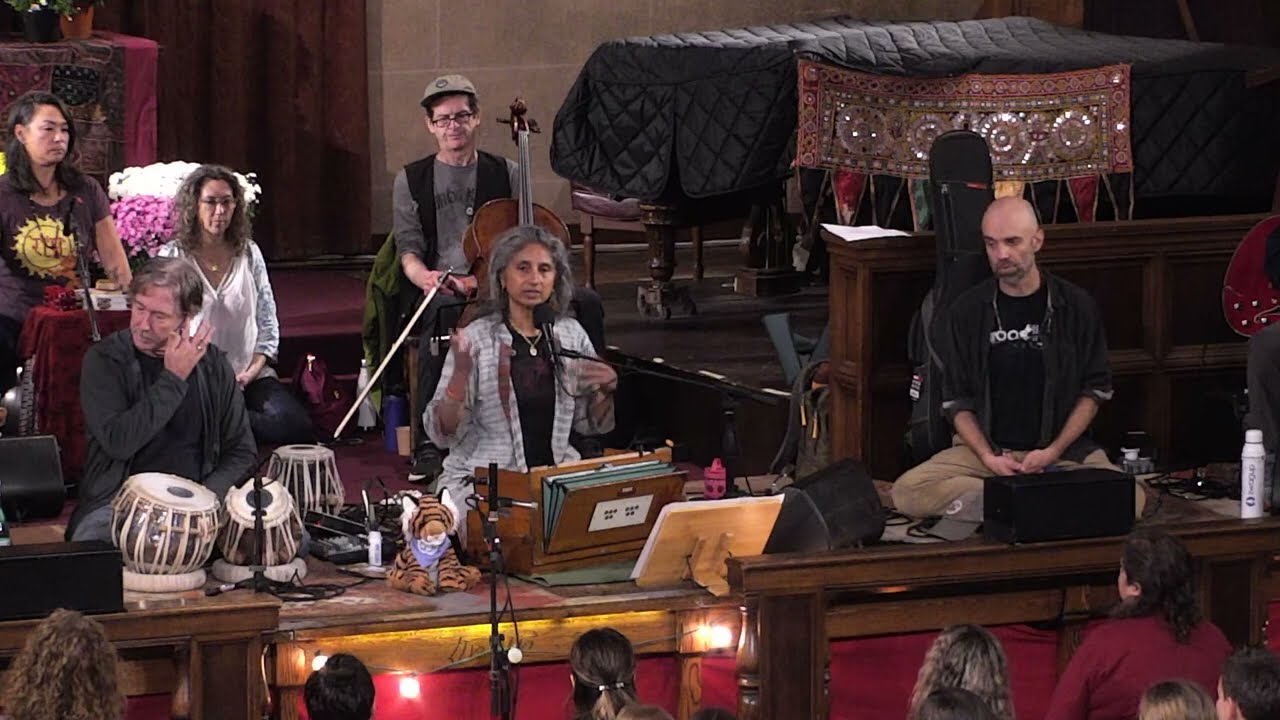
In this 2010 performance at Yoga Pela Paz in São Paulo, Brazil, Jai Uttal and Krishna Das lead a kirtan of "Jaya Bhagavan," a Sanskrit chant that invokes divine presence and celebrates the Self. Kirtan—call-and-response sacred singing—functions as a direct path to devotion and heart-opening, bypassing intellectual understanding to create a shared field of collective consciousness. The practice combines melody, rhythm, repetition, and communal participation to dissolve ego boundaries and align participants with what many spiritual traditions call the ultimate ground of being.
What Is Kirtan and Why Does It Matter in Contemporary Spiritual Practice?
Kirtan is a devotional singing practice rooted in Hindu and Sikh traditions, though it has traveled across cultures and contexts. Unlike meditation, which often involves silence or internal focus, kirtan invites practitioners into active, participatory chanting. The structure is typically call-and-response: a leader sings a phrase, and the community echoes it back. This creates a feedback loop that builds energetic resonance and draws attention away from the individual mind into a collective field.
Jai Uttal, a pioneering figure in bringing kirtan to Western audiences, has spent decades exploring how Sanskrit chants—ancient sound formulas—work on both neurological and energetic levels. In performances like the one at Yoga Pela Paz, the simplicity of the form belies its depth. A single chant like "Jaya Bhagavan" (meaning "Glory to the Divine," or literally "Victory to God") can be repeated for 20 or 40 minutes, with the melody and rhythm evolving through the session. This extended repetition allows the rational mind to gradually settle, opening space for what practitioners describe as direct experience of presence or the heart's inherent wisdom.
How Does the Melody of "Jaya Bhagavan" Open Emotional and Spiritual Pathways?
The specific chant "Jaya Bhagavan" carries particular frequencies and emotional valences. The word "Jaya" itself means victory or glory—an affirmation. "Bhagavan" refers to the Divine, often understood in Advaita Vedanta as one's own deepest Self. When sung repeatedly, the chant becomes a kind of prayer-affirmation hybrid, affirming one's connection to divinity not as an external supplication but as a recognition of what already is.
The melody Uttal and Krishna Das use in this performance is designed to be accessible while still carrying the weight of tradition. Both singers are known for their skill in modulating depth and accessibility: they honor the Sanskrit pronunciation and the emotional intention of the chant while remaining sensitive to their audience's level of experience. This balance—between authenticity to tradition and openness to contemporary practitioners—is one of Uttal's distinct contributions to kirtan in the West.
When chanted in a group, "Jaya Bhagavan" becomes a vehicle for collective awakening. The combination of:
- Repetitive melody that allows the thinking mind to relax
- Devotional intention embedded in the Sanskrit words
- Synchronized breathing and vocalization across a group
- The presence of experienced practitioners (Uttal and Krishna Das) holding the field
What Happens in the Body and Nervous System During Kirtan?
While the video is a performance rather than a teaching, understanding the somatic dimensions of kirtan helps explain why this practice has persisted across millennia. Chanting activates the vagus nerve—the parasympathetic pathway that signals safety to the nervous system. The repetitive vocalization, particularly the sustained tones common in Sanskrit chants, massages the vagus nerve and can shift practitioners out of sympathetic (fight-flight) activation into parasympathetic (rest-digest) states.
The rhythmic component also synchronizes brain activity across participants. Neuroimaging studies of group chanting show coherence in oscillatory brain patterns—a kind of neural synchrony—when groups sing or chant together. This is not metaphorical connection; it is measurable coherence in the electrical activity of multiple brains entering the same frequency. For practitioners, this feels like "entering the field" or "merging with the group consciousness."
The breath also plays a crucial role. Kirtan, especially when held for extended periods, involves rhythmic breathing that naturally balances the nervous system. The combination of sustained tones, group synchronization, and conscious breathing creates a felt shift that participants recognize as moving from individual, goal-oriented mind into a state of presence and communion.
Why Did Jai Uttal and Krishna Das Perform at Yoga Pela Paz?
Yoga Pela Paz (Yoga for Peace) was a significant conscious community gathering in São Paulo, Brazil, in 2010. The choice of "Jaya Bhagavan" for this venue reflects the organizers' intention: to use the transformative power of chanting for collective healing and spiritual alignment. Brazil has a rich spiritual heritage, including significant African diaspora traditions, Spiritism, and indigenous wisdom, alongside growing interest in yoga and Vedantic teachings. The convergence of Uttal, Krishna Das, and a Brazilian audience represented a genuine cross-cultural spiritual moment.
Both Uttal and Krishna Das are known for their humility and genuine devotion to the practice itself, not to their own fame. They are not performers in the entertainment sense; they are practitioners who invite others into practice. This distinction—between a musician who performs for an audience and a kirtan leader who facilitates collective chanting—is central to understanding what happens in such events.
What Can We Learn From the "Jaya Bhagavan" Practice About the Nature of Devotion?
The chant itself contains a teaching: "Jaya" suggests not defeat of enemies but victory over ignorance, over the illusion of separation. "Bhagavan"—understood in classical Vedanta—is not a person outside ourselves but our own true nature. So the chant, when understood, is an affirmation of the recognition of one's own divinity and the divinity of all beings.
This is radical because it bypasses doctrine and philosophy and places practitioners directly in the experience of unity. You do not have to believe anything about the Divine; you simply chant and allow the frequencies, the community, and your own nervous system to show you what is true. The evidence, for most practitioners, is in the felt sense: the heart opening, the release of tension, the spontaneous tears or laughter, the sudden clarity, the sense of coming home.
Devotion, in this context, is not emotional sentimentality or blind faith. It is the alignment of the heart's intention with what one intuits to be true. Every time the word "Bhagavan" is sung, there is an implicit recognition: the Divine is not elsewhere. It is the ground of my own being, right now.
How Does a Single Performance Like This Ripple Into the Wider Culture?
This August 2010 performance at Yoga Pela Paz occurred in a particular moment in the history of kirtan in the West. Uttal and Krishna Das were among the pioneering figures who brought authentic kirtan—rooted in genuine spiritual practice rather than commodified "spiritual music"—to audiences outside South Asian Hindu contexts. Over the past 15+ years, their work and that of others has contributed to a widespread recognition that chanting is not exotic or culturally appropriative but a universal human practice that serves awakening.
When such a performance is recorded and shared online (as this one has been, with over 94,000 views), it extends the impact far beyond the room. People listen to "Jaya Bhagavan" in their homes, in their cars, in hospital rooms. The recording becomes a kind of portable sangha—a community of practice. Some listeners use it for meditation, others for emotional healing, others as a way to deepen their own devotional connection to the Divine.
The fact that this specific performance was documented and remains accessible speaks to the importance of such events. Spiritual practice is often ephemeral—a moment of grace that passes. By recording and preserving these moments, they become teaching tools and invitations for others to explore the territory themselves.
Where to Go From Here
If this exploration of "Jaya Bhagavan" resonates with you, several directions are worth considering:
Practice the chant yourself: Listen to the recording multiple times, learn the melody and words, and consider chanting along. Notice what shifts in your body, mind, or emotional state. Kirtan's power is not in observation but in participation.
Attend a live kirtan: While recordings are valuable, the live experience of collective chanting is qualitatively different. The presence of experienced practitioners and the synchronization of a live group creates a resonance that audio cannot fully capture. Jai Uttal, Krishna Das, and other kirtan leaders continue to lead public kirtan circles and retreats.
Explore the Sanskrit meaning more deeply: Learn about the concepts embedded in the chant—what "Jaya" means, what "Bhagavan" points to in the Vedantic tradition. This intellectual understanding, combined with embodied practice, creates a fuller integration.
Consider the role of chanting in your own spiritual path: Whether you come from a Hindu, Christian, Buddhist, Sufi, or secular background, chanting and singing have always been pathways to the sacred. What chants or songs resonate with your own deepest intuition? Kirtan offers a form, but the essential practice—of aligning voice, heart, and intention—is available to anyone.