The Sage's Path: Embracing Action Without Contention
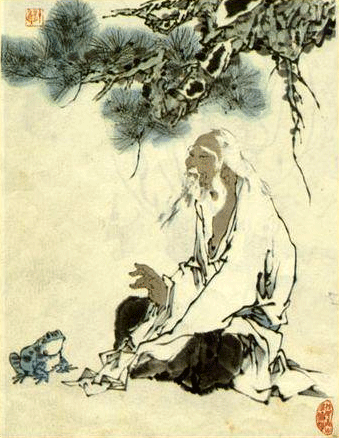
Chuang Tzu's assertion, "The way of the sage is to act and not contend," invites us to explore a profound approach to life that transcends mere action. In essence, he suggests that true wisdom lies not in the struggle for dominance or recognition, but in the ability to engage with the world from a place of inner peace and authenticity. This perspective challenges the often competitive nature of our society, urging us to consider how we might navigate our lives with grace and intention, rather than conflict.
To act without contention is to embody a state of being that is both powerful and serene. It calls for a deep understanding of oneself and the world, where actions arise from a place of clarity rather than reaction. In a world rife with discord and competition, Chuang Tzu's wisdom offers a refreshing alternative: a way of living that prioritizes harmony over strife, inviting us to reflect on our motivations and the impact of our actions on ourselves and others.
The image / the metaphor
At the heart of Chuang Tzu's quote lies a rich tapestry of imagery that evokes the essence of the sage's journey. The phrase "to act" suggests a dynamic engagement with life, a movement that is both intentional and responsive. In contrast, "not contend" conjures the image of a flowing river, unperturbed by obstacles, moving forward with purpose without the need to clash against the rocks that might impede its path. This duality encapsulates the sage's approach: to engage actively with the world while remaining detached from the need to win or dominate.
Diving deeper into the metaphor, we can see that the sage embodies a state of being that is rooted in understanding and acceptance. The act of engaging without contention implies a profound trust in the natural order of things, a recognition that life unfolds in its own time and manner. This perspective allows the sage to navigate challenges with ease, responding to situations with wisdom rather than aggression, and embracing the flow of existence rather than resisting it.
In the speaker's tradition
Chuang Tzu's teachings are deeply embedded in the Taoist tradition, which emphasizes harmony with the Tao, or the fundamental nature of the universe. This concept resonates with the idea of non-contention, as it encourages individuals to align their actions with the natural rhythms of life rather than impose their will upon it. In this context, the sage embodies the principle of wu wei, or "effortless action," which advocates for a way of being that is both active and non-striving, allowing for a more authentic expression of one's true nature.
In the text of the Zhuangzi, we find numerous parables that illustrate the wisdom of the sage and the futility of contention. One such story involves a debate between a skilled cook and a philosopher, where the cook demonstrates that true mastery lies not in argumentation but in the art of understanding and flowing with the essence of his craft. This narrative reinforces the idea that wisdom is found in action that is harmonious and aligned with the greater whole, rather than in the pursuit of victory over others.
Living the teaching
Consider a modern scenario where this teaching can be applied: a workplace environment characterized by competition and ambition. In such a setting, individuals often find themselves vying for recognition, leading to stress and conflict. By embodying the sage's approach, one might choose to focus on collaboration rather than contention, seeking to uplift colleagues and contribute to a shared vision. This shift in perspective not only fosters a more harmonious workplace but also allows for personal growth and fulfillment, as actions are rooted in genuine connection rather than rivalry.
In the realm of personal relationships, the teaching of acting without contention can be transformative. Imagine a disagreement with a loved one, where emotions run high and the urge to "win" the argument is strong. By embracing the sage's wisdom, one can choose to listen deeply and respond with empathy, prioritizing understanding over the need to be right. This practice not only diffuses tension but also deepens the bond between individuals, creating a space where love and respect can flourish without the shadow of contention.
A reflection
As we contemplate Chuang Tzu's profound insight, we are invited to reflect on our own lives: How often do we find ourselves in contention, whether in our thoughts, actions, or relationships? What would it look like to approach our challenges with the grace of the sage, acting from a place of inner peace rather than striving for dominance? In this moment of reflection, consider: How can you embody the wisdom of the sage in your daily interactions, allowing your actions to flow naturally without the weight of contention?



Join the BrightStar Community
Stay connected with daily inspiration, event announcements, and community wisdom