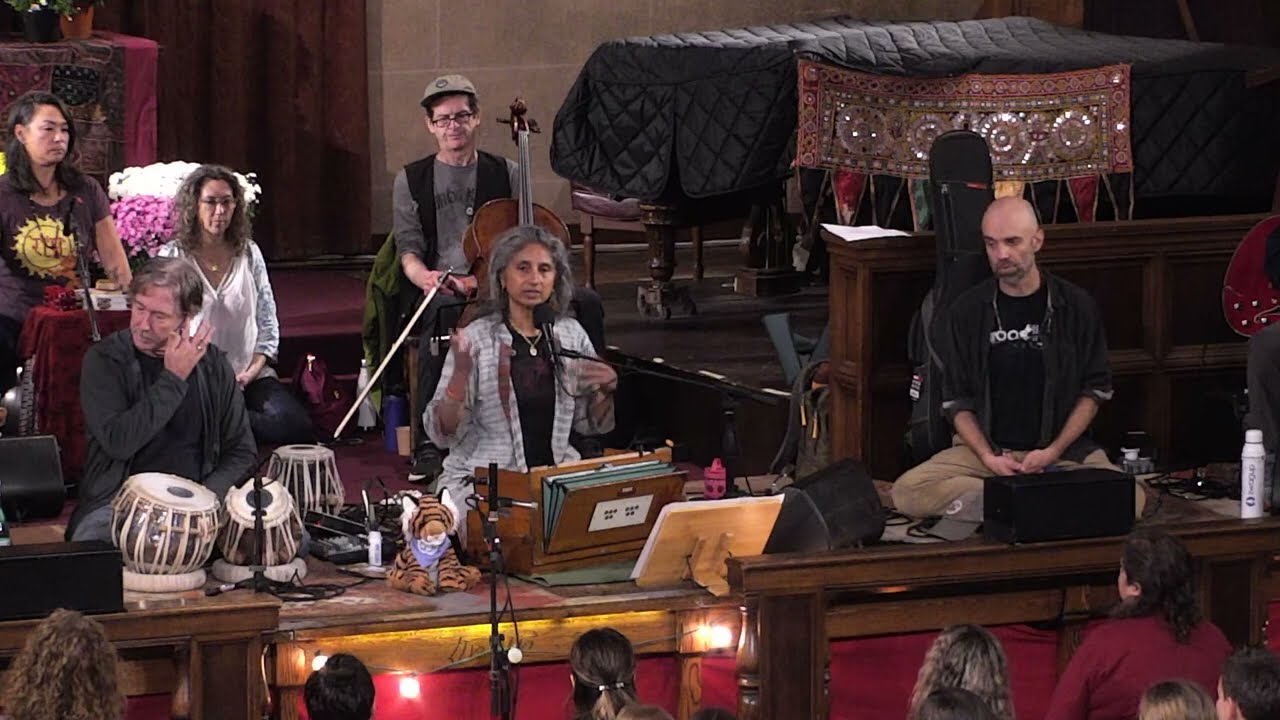
At a 2013 book launch for Love Your Enemies by Robert Thurman and Sharon Salzberg, Grammy-nominated kirtan artist Krishna Das opened the event with a performance of the Saraswati chant. This classical Sanskrit mantra invokes Saraswati, the Hindu goddess of wisdom, knowledge, and learning, and represents the bridge between devotional practice and contemporary spiritual community. The chant demonstrates how traditional dharmic practice remains alive and accessible in modern settings, drawing together audiences seeking both intellectual and devotional approaches to spiritual life.
What Is the Saraswati Chant?
The Saraswati chant is a mantra-based invocation dedicated to Saraswati, one of the principal deities in the Hindu pantheon. In Sanskrit literature and Vedic tradition, Saraswati embodies the qualities of wisdom, eloquence, music, and the arts. The chant typically centers on the mantra "Om Sarasvatyai Namah" and variations thereof—a salutation that honors Saraswati and calls upon her blessings for clarity of thought, creative expression, and spiritual knowledge.
Unlike meditative silence or visualization practice, chanting serves as an active form of devotion. When practitioners repeat the mantra, they engage multiple sensory and cognitive channels: the vibration of sound in the throat and body, the meaning embedded in the Sanskrit syllables, the communal resonance when chanting in a group, and the psychological shift that occurs through rhythmic repetition. In this way, the Saraswati chant functions both as prayer and as a form of meditation-in-motion.
Who Is Krishna Das and Why Does This Chant Matter?
Krishna Das is a kirtan artist and spiritual practitioner whose music has brought Hindu devotional chant into Western consciousness. Nominated for a Grammy Award, he is known for making Sanskrit mantras accessible to contemporary audiences while maintaining their traditional integrity. His approach bridges the gap between academic interest in Eastern spirituality and lived devotional practice, making these tools available to people regardless of their religious background or previous exposure to Hindu tradition.
At this book launch event—held at ABC Home & Carpet in New York on October 1st, 2013—Krishna Das's performance served a specific purpose. The event centered on the publication of Love Your Enemies, co-authored by Robert Thurman, a scholar of Tibetan Buddhism and Columbia University professor, and Sharon Salzberg, a pioneering American Buddhist teacher. By opening with the Saraswati chant, Krishna Das was not simply providing musical entertainment; he was creating a container for the intellectual and ethical work to follow. The goddess of wisdom was being invoked to bless both the teachings about compassion and the gathering itself.
How Does Mantra Practice Connect to the Theme of Loving Enemies?
On its surface, invoking the goddess of wisdom before discussing how to love one's enemies might seem coincidental. Yet there is a deep philosophical alignment. Loving enemies requires wisdom—specifically, the capacity to see beyond the surface of someone's harmful actions to recognize their shared humanity, their suffering, their potential for transformation. This kind of discernment is precisely what Saraswati represents. She is not merely the goddess of intellectual knowledge but of jnana, the liberating insight that transforms how we understand reality itself.
In Buddhist and Hindu philosophical systems, wisdom is not separate from compassion. True understanding of the nature of suffering and interdependence naturally generates compassion for all beings, including those who cause harm. By chanting to Saraswati at the opening of this event, the community was collectively requesting the clarity and understanding necessary to move beyond reactivity toward enemies and into the territory of genuine love—the kind that neither denies harm nor surrenders to hatred.
What Is the Significance of Communal Chanting?
The event recording captures not only Krishna Das's voice but also the presence of an audience responding with applause and participation. This communal dimension transforms the chant from a solo performance into a collective practice. When people chant together—whether they know all the words or simply attune themselves to the vibration and intention—something shifts in the nervous system and in the group field.
Research in contemporary psychology and neuroscience has begun documenting what practitioners have long known: rhythmic vocalization, especially in a group setting, activates the parasympathetic nervous system, reduces stress, and increases coherence. The shared vibration of a mantra creates what some neuroscientists call "neural synchrony"—a coordinated firing of brain regions across individuals. This is not mystical; it is physiological. Yet it points toward something that traditions have always recognized: that human beings can resonate together toward a shared intention.
In the context of a book launch about loving enemies, this communal practice becomes pedagogical. Before Thurman and Salzberg could speak about compassion and enemy-love, the audience's bodies and voices had already been synchronized in an act of devotion. The intellectual arguments that followed would land in nervous systems already slightly more open, slightly less defended.
Where Does the Saraswati Chant Sit in Contemporary Western Spirituality?
The presence of Krishna Das at this event, and events like it, signals a shift in how Western spirituality has evolved. For much of the twentieth century, Eastern practices were often divorced from their devotional and mythological contexts. Meditation was taught as a secular technique; mantras were stripped of their religious meanings and repackaged as "scientifically validated" tools. There was value in this translation, but also something lost.
In recent years, there has been a reclamation. Teachers and practitioners, particularly those trained in both Eastern and Western contexts, have begun recognizing that the devotional and mythological dimensions of these practices are not obstacles to understanding—they are integral to how they work. The Saraswati chant at this book launch represents this reclamation. It is performed by an artist rooted in classical Hindu tradition (Krishna Das has spent decades studying and practicing in India) but presented in a setting—a New York design showroom—that would have seemed unlikely a generation ago.
This integration suggests that Western practitioners are becoming more comfortable with the paradox: one can engage seriously with Hindu deities and mantras without converting to Hinduism, just as one can practice Buddhist meditation without adopting all aspects of Buddhist culture. The wisdom traditions themselves have always held this possibility open—they are, at their core, portable. They travel because they address perennial human concerns: how to reduce suffering, how to cultivate wisdom, how to love more fully.
What Happens When We Chant Saraswati's Name?
At the most literal level, chanting "Saraswati" and its variations (such as "Sarasvatyai Namah," meaning "I bow to Saraswati") is an invocation. You are calling on a quality, a power, an archetype. Whether one understands Saraswati as a literal deity, as a personification of wisdom-energy within consciousness, or as a symbol and psychological anchor matters less than the intention and attention brought to the practice.
The sounds themselves carry meaning. The "S" sounds (sibilants) in Saraswati are associated with lightness and clarity. The "a" vowels are grounding and centering. The "swati" ending evokes flow and movement. When chanted, these syllables create a particular resonance in the body. Practitioners often report feeling a subtle shifting in the throat, chest, and head—not metaphorically, but as a direct sensory experience. Over time and with regular practice, these micromovements in attention and physiology can lead to shifts in how one perceives and thinks.
More importantly, the act of calling on Saraswati is an acknowledgment that wisdom is not something we manufacture alone but something we can open ourselves to receive. It is a gesture of humility in the face of the unknown and a declaration of readiness to learn, to see clearly, to speak truthfully.
Where to Go From Here
If you are curious about exploring chant practice yourself, look for local kirtan or mantra circles in your community, or find recorded chants online through artists like Krishna Das. You need not commit to any particular belief system to benefit from the practice. Begin by simply listening, allowing the vibrations and rhythms to affect you, and notice what shifts internally. If you are interested in the philosophical foundations underlying this practice, read into Hindu and Buddhist texts on wisdom (jnana or prajna) and how they connect to ethical living and compassion. Finally, if the context of loving enemies resonates, explore Thurman and Salzberg's work directly—the teachings they offer in Love Your Enemies provide a contemporary, philosophically rigorous framework for why wisdom and compassion are inseparable, and how they can be cultivated in our daily lives.