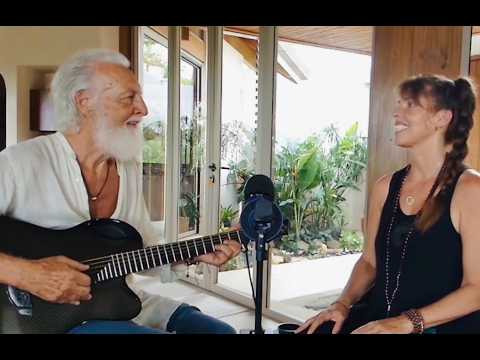
"All the Birds Fly Home" is an unreleased kirtan composition (by Prem Dipamo and Manu Bazzano) performed by Deva Premal & Miten as the final song of their 30-day "Singing Our Prayers" European Tour 2023. Filmed at the Circus Krone in Munich, this live performance captures the spiritual and emotional closure of a monthlong devotional journey, with musicians and audience gathered in what the performers describe as a "wonderfully communal space of wonderment." The piece exemplifies how kirtan—call-and-response devotional singing—functions not just as musical performance but as a collective ritual that creates shared spiritual intimacy at the end of an intensive practice period.
What is the significance of a closing song in a devotional tour?
The closing moment of a multi-week devotional tour carries particular weight in spiritual practice. After 30 consecutive days of "Singing Our Prayers," both musicians and audience members have moved through a cumulative deepening of practice. The final song marks not a conclusion of the music itself, but a formal acknowledgment that the intensive container is ending—a ritual farewell. In kirtan traditions, the closing bhajan (devotional song) often functions as a benediction, a way for practitioners to integrate their experience and consciously part with the energy they have collectively created. Miten and Deva Premal's choice to perform an unreleased composition as this final piece suggests intentionality: a unique gift offered only to those present, a mark of the irreplaceable nature of that particular gathering.
How does kirtan create communal spiritual experience?
Kirtan is a participatory form of devotional singing in which a leader chants a call (often a mantra or sacred phrase) and the community responds in unison. Unlike concert performances where the audience is passive, kirtan invites all voices into a shared sonic field. The repetition of sacred phrases, combined with the collective breath of dozens or hundreds of voices, creates a kind of attunement where individual consciousness begins to dissolve into group consciousness. This is not metaphorical: neuroscience research suggests that synchronized singing and breathing can synchronize nervous systems and heart rates, creating measurable physiological coherence. The description of the Munich audience and musicians gathering in "a wonderfully communal space of wonderment" points to this quality—the shift from "I am singing" to "we are singing," which many practitioners recognize as the threshold where personal ego quiets and collective devotion emerges.
What role does the live band play in amplifying devotional practice?
The Temple Band—composed of Joby Baker (bass, oud, vocals), Spencer Cozens (piano, keyboards), Miles Bould (drums, percussion), and Richard Moody (viola, violin, mandolin, vocals)—functions not as accompaniment but as a container and amplifier for the kirtan space. Each musician holds a particular role: the rhythm section (bass and drums) provides the heartbeat that anchors the group's collective breathing; the harmonic instruments (piano, strings) create the emotional resonance and harmonic depth that allows voices to find their pitch; the additional vocalists expand the harmonic and emotional complexity. A skilled devotional band does more than keep time—it listens intuitively to the energy of the gathering and shapes the arc of the song to meet the group's evolving state. The fact that this performance was filmed at the end of a 3-hour concert means The Temple Band had spent hours in the same shared spiritual field, so by the closing song, their playing would reflect not technique alone but genuine communion with the singers and audience.
Why might an unreleased composition serve as a tour's final offering?
Using a previously unreleased piece ("All the Birds Fly Home," composed by Prem Dipamo and Manu Bazzano) as the closing song of a 30-day European tour suggests a deliberate artistic and spiritual choice. An unreleased composition cannot be known in advance; it cannot be rehearsed or prepared by the audience beforehand. This means that everyone present—singers and listeners alike—encounters it fresh, in real time, without expectation or previous familiarity. In the context of closure, this creates a unique moment of vulnerability and discovery shared by all. The title itself, "All the Birds Fly Home," carries metaphorical weight: birds often symbolize the soul in spiritual traditions, and the image of multiple birds returning home suggests both individual journeys and collective homecoming. The composition's premiere at the tour's conclusion transforms it into a living memory for everyone present—a unique spiritual artifact tied to that specific gathering that cannot be replicated elsewhere.
What does the tour logistics reveal about sustaining devotional practice at scale?
The credits listed in the video description—tour manager Jackson Lapes, sound engineers Med Rann and Kevan Snuggs, lighting designer Cyril Van Lierde, drivers, merchandise coordinators—reveal an essential infrastructure often invisible in spiritual performance. Maintaining a 30-day tour across Europe while preserving the devotional integrity of hourlong kirtan sets requires meticulous logistical coordination. Sound quality must be pristine so that the subtleties of harmonics and vocal blending reach the audience clearly. Lighting must support the contemplative mood without distraction. Travel, accommodation, and rest must be managed so that musicians can sustain both physical stamina and spiritual availability. The presence of Jackson Lapes as tour manager (and the joking notation "Driver - Justin (not-stopping) Fellows") hints at the human labor required to make intensive devotional touring sustainable. This infrastructure matters because it allows practitioners to sink into the spiritual work without distraction, knowing that practical concerns are being held by others.
How does filming and sharing a live kirtan affect its spiritual power?
Recording and distributing a live kirtan performance raises a subtle question about the nature of spiritual experience. In traditional kirtan, the power lies partly in presence and irreplaceability—you must be there, in that moment, with those people, to receive the full transmission. Yet the decision to film and share this Munich closing moment (credits to filmmaker Ronny Barthel and editor Jeanny Tsai) extends the blessing beyond that night. For viewers who watch the recording, they encounter not a performance but a documented moment of collective devotion—a spiritual artifact that can inspire and attune their own practice even at a distance. The video becomes a kind of initiation or invitation into the quality of consciousness that was present in the room. Additionally, by sharing this unreleased composition publicly, Deva Premal & Miten offer "All the Birds Fly Home" to a global audience, transforming a private closing moment into a teaching tool and devotional resource. This reflects a contemporary approach to spiritual sharing: sacred transmission is not diluted by being recorded and shared; rather, it is honored by being offered widely.
What is the relationship between 30-day intensive practice and spiritual completion?
Thirty days is a significant threshold in spiritual practice traditions. In many yogic and bhakti lineages, a 40-day sadhana (spiritual practice) is considered a complete cycle, but 30 days also carries meaning as a full lunar month. Singing prayers every day for 30 days creates a cumulative effect: the nervous system recalibrates, emotional patterns begin to shift, and the voice itself becomes more capable of holding sacred vibration. By day 30, both performers and audience have moved through a genuine transformation—not overnight enlightenment, but a tangible loosening of habitual patterns and a deepening of capacity to hold devotional states. The final song thus arrives not as an arbitrary endpoint but as a natural completion. In the context of the "Singing Our Prayers" tour, the 30 days function as a contained spiritual laboratory where devotion has been the primary activity. The closing kirtan acknowledges this completion while also recognizing that the real work—integrating the shift in consciousness into daily life—now begins for each practitioner returning home.
Where to go from here
If you were moved by this moment of communal devotion, consider attending a live kirtan gathering in your own community or exploring kirtan recordings by Deva Premal & Miten as a daily practice. The "Gayatri Sangha App" (available through devapremalmiten.com) offers access to their teachings and recordings for sustained practice. Deva Premal & Miten continue their "Singing Our Prayers" tour throughout 2024 across Europe, with concerts scheduled in Dublin, Mallorca, Sweden, Prague, London, Berlin, and other cities—opportunities to experience live kirtan in a similar intensive, communal setting. Whether through live attendance or recorded practice, kirtan offers a accessible entry point into devotional consciousness: no prior knowledge is required, only willingness to sing and listen with an open heart.