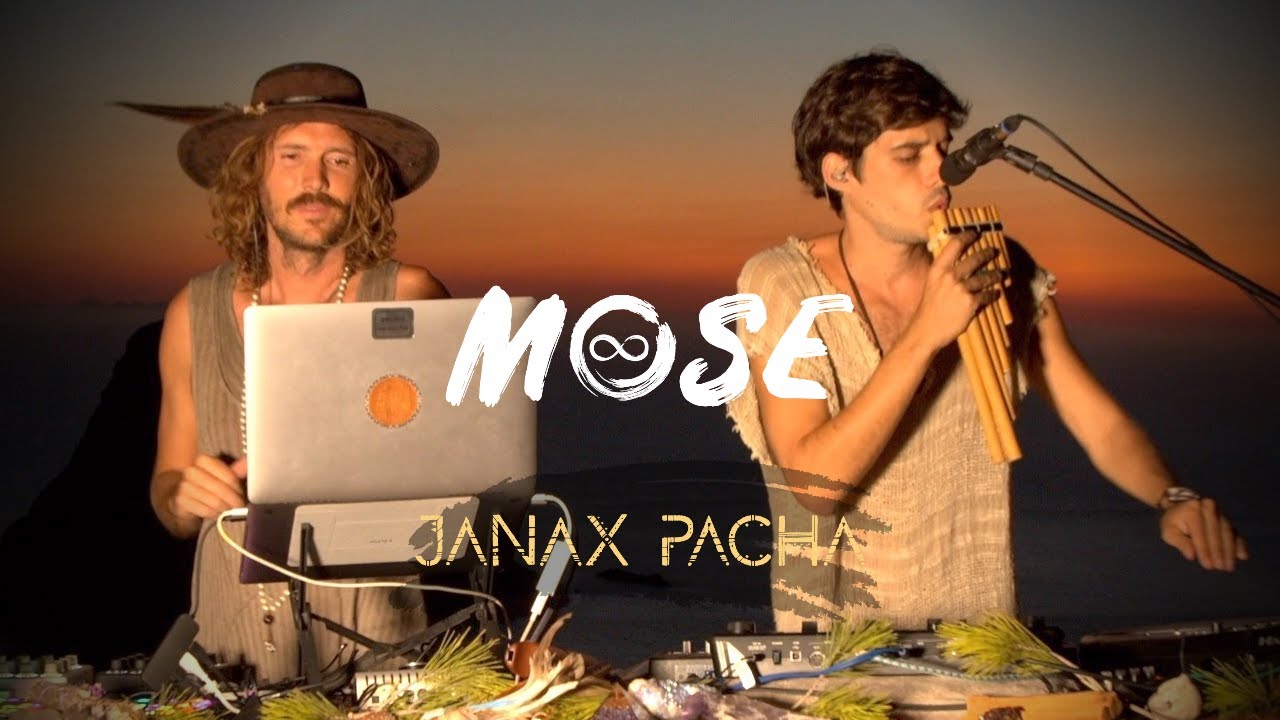
At Heart Culture Festival 2017 in Austria, electronic musician and producer Mose performed alongside vocalist Suyana in a completely unrehearsed, real-time improvisation. Rather than following pre-arranged songs, Mose used clips and loops to compose arrangements on the fly in response to the energy of the crowd, while Suyana sang over eight different song structures spanning devotional chants, spiritual poetry, and collaborative originals. The result demonstrates a compositional approach where technology serves the moment rather than constraining it—a hybrid of electronic production, kirtan tradition, and collective attunement.
What Does Real-Time Electronic Composition Look Like?
The performance documented here challenges the conventional separation between production and live performance. Mose arrived with a library of loops and clips—building blocks rather than finished arrangements—and constructed each song during the set itself. This approach mirrors improvisation in jazz or classical music, but with electronic tools that allow multiple layers to be triggered, looped, and manipulated in real time. Rather than pressing "play" on a pre-recorded backing track, he was actively composing the harmonic and rhythmic foundation while simultaneously responding to Suyana's vocal choices and the audience's energy state.
This method requires a different skill set than either traditional music production or standard DJ performance. The producer must hold multiple possible arrangements in mind, understand how clips can be layered to create coherence, and maintain musical sensitivity to the unfolding moment. It is closer to conducting than to either playing an instrument or curating a playlist.
How Does Kirtan Function Within Electronic Music?
Kirtan—call-and-response chanting rooted in Indian devotional traditions—has increasingly appeared in electronic and ambient music contexts, particularly in conscious dance and festival spaces. Suyana's role in this performance was not to provide text set to predetermined melodies, but to respond to the evolving sonic landscape that Mose was building. This creates an unusual dynamic: the vocalist is not simply performing over instrumentals, but is partnering with the producer to shape the emotional and energetic arc of each section.
The eight pieces performed—including original songs written by Suyana, Nalini Blossom, and Mose himself—suggest a repertoire shared among a wider community of artists working at this intersection. Songs like "Shante Ishta" and "Raise Your Voice," credited to Suyana, indicate that this is not a one-off collaboration but part of an ongoing creative ecosystem where specific pieces are co-created and shared among multiple performers.
What Role Does Community Presence Play in Improvisation?
Mose's description of the performance emphasizes that "people really tuned in and offered us the opportunity to dive deep into experimentation." This frames the audience not as passive listeners but as active participants in the energetic and creative field. In spiritual and conscious music contexts, the concept of collective attunement is significant: the performers' choices are understood to be responsive to the "vibe" or energetic resonance of the room, not merely to technical or aesthetic decisions made in advance.
This perspective suggests that the same set list performed on a different night to a different crowd would yield a genuinely different performance, not just in execution but in the fundamental compositional choices made moment to moment. The arrangement of "Shiva Shambo," for example, would be shaped by what Mose perceived the audience needed to go deeper into at that specific moment in the set.
Which Tracks Were Created Specifically for This Performance?
The set list reveals a mixture of strategies. Several pieces appear to be remixes of existing work: "Roots of the Earth" and "Fire Gathering" from Liquid Bloom, and "Wanderlust" by Lannka, all feature Mose's remix production. Other songs—particularly "Shiva Shambo"—existed only as loop packs at the time of this performance and have not been released in any other form. This means the arrangement heard here is the only official recording of this song, captured live in its unique instantiation.
Songs credited to Suyana and Nalini Blossom appear to be core pieces in a shared songbook, possibly indicating formal compositions that are adapted differently depending on context and collaborators. The hybrid nature of the set—mixing entirely improvised arrangements, remixed familiar material, and original compositions—mirrors the broader aesthetic of the performance: integration rather than purity of form.
How Does Loop-Based Production Enable or Constrain Spontaneity?
Loop-based music—where a recorded phrase is repeated and layered—offers both freedom and structure. The constraints are valuable: once a harmonic and rhythmic foundation is established through loops, both the vocalist and audience have a stable ground on which other creative choices can unfold. But the loops themselves are built in real time, meaning there is no preset harmonic progression that predetermines what the vocalist can sing or how the energy can shift.
This differs significantly from backing tracks, where the harmonic and rhythmic structure is locked before the performance begins. It also differs from fully free improvisation with no harmonic anchor, where singers and musicians must maintain internal coherence across all elements simultaneously. Loop-based real-time composition sits in the middle: there is enough structure to allow focused creative work, but enough flexibility to follow intuition and group intelligence.
What Does an Unreleased Track Mean in the Context of Digital Distribution?
Mose notes that most of the music in the set has since been officially released on streaming platforms and his own Bandcamp, but "Shiva Shambo" remains unreleased except as loops. This creates an interesting archival status: the performance video itself becomes the only fixed recording of this particular piece, even as other songs have been refined and polished for official release. For listeners and researchers, the live performance serves as both documentation and primary source material.
The existence of a Spotify playlist containing "these songs" (linked in the description) suggests that platforms like Spotify now accommodate both live recorded performances and studio versions, allowing audiences to explore the differences between how a piece unfolds in real time versus how it is constructed in a studio context.
Where to Go From Here
Listeners interested in this performance can explore Mose's full discography on Spotify, Bandcamp, and Soundcloud, where both the music featured here and his other productions are available. The Heart Culture Festival series represents a documentation of a live performance practice; those seeking to understand the creative process behind the pieces can follow Mose's Patreon, which offers access to additional mixes and unreleased material. Suyana's work can be found on her official site (suyana.net) and through the "Medicine Women" series on YouTube, which features her alongside Mose, Nalini Blossom, and other collaborators. For those interested in the broader context of kirtan in electronic and festival music, the Liquid Bloom remixes serve as another entry point into how traditional devotional forms are being adapted in contemporary production.