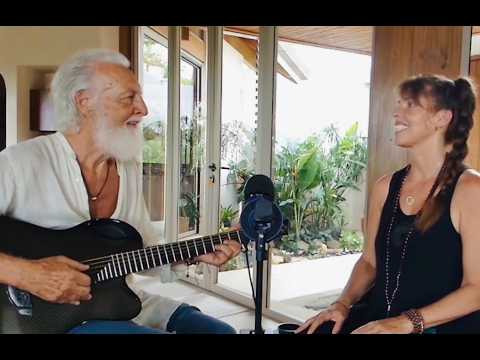
Miten and Deva Premal announce their 2024 summer tour across European festivals—including performances at Greator Festival in Cologne, festivals in Ireland, Spain, and Sweden—framed around the healing power of collective chanting and kirtan as genuine spiritual nourishment. In an era of AI and misinformation, they position live communal singing as one reliable form of authentic transformation and connection, inviting kindred spirits to gather and pray through music.
Why Chanting and Community Matter When the World Feels Chaotic
In a world where chaos and uncertainty dominate headlines, Miten and Deva Premal offer a direct response: gather, sing, and chant together. Their message for the 2024 summer festival season centers on a simple but profound premise—that collective singing and prayer are forms of real nourishment when so much else feels fragile or fake.
The teachers acknowledge a particular anxiety of our current moment: in an age of artificial intelligence and digital manipulation, we cannot always trust what appears real or true in media and information systems. Yet there remains one thing we can rely on, they suggest. When you stand in a room with others, breathing the same air, singing the same mantras, feeling healing energy stream through your entire being, that experience is undeniably real. It is not mediated through screens. It is not generated by algorithms. It is felt, lived, present.
This framing transforms the summer festivals from entertainment events into something deeper—spaces of resistance to inauthenticity, and containers for genuine transformation through sound and sacred community.
What Is the Role of Collective Singing in Spiritual Transformation?
Kirtan and chanting, the musical forms that Deva Premal and Miten are known for, are not passive listening experiences. They are participatory acts. When dozens or hundreds of people sing the same Sanskrit mantras or devotional prayers together, the experience engages body, breath, nervous system, and consciousness simultaneously.
The teachers describe this state as "bathing in the Here and Now"—a shift away from the fractured, future-oriented attention that dominates modern life. Chanting naturally draws the mind into the present moment because the breath, voice, and sound must be coordinated in real time. There is no room for rumination or distraction when you are singing.
They also emphasize that healing energy streams through the veins and whole being during collective singing. This is not merely metaphorical language. Modern research on singing, breathing, and the nervous system has shown that group chanting can regulate the vagus nerve, lower cortisol, and activate parasympathetic (rest-and-digest) responses. The tradition of kirtan has long understood this: the vibration of the mantra, the synchrony of the group, and the intentional devotion create a somatic and psychological shift.
For Miten and Deva Premal, this transformation is not a side effect of festival attendance—it is the core purpose and the actual nourishment being offered.
Where Are Deva Premal and Miten Performing in Summer 2024?
The tour spans seven major European festivals and cities across three months:
- June 22: Greator Festival, Cologne, Germany
- June 24: Dublin, Ireland
- June 26: Palma, Mallorca, Spain
- July 6: Om Am See Yoga Festival, Füssen, Germany
- July 8: Bhakti Yoga Summer Music Festival, Wardenburg, Germany
- July 17–18: Yoga Mela Festival, Divinya, Sweden
- July 20: Colours of Ostrava Festival, Ostrava, Czechia
Additional dates are scheduled for September and October 2024. The geographic spread—from Ireland to the Czech Republic, from Germany to Sweden—reflects the growing appetite across Europe for kirtan and devotional music as forms of spiritual practice and healing.
Each festival offers a different context: some are explicitly yoga or spiritual festivals (Om Am See, Bhakti Yoga Summer Music Festival, Yoga Mela), while others are broader cultural festivals that feature music and arts alongside spirituality (Greator, Colours of Ostrava). This variety allows people to encounter the work in their own region or to make pilgrimage to a destination they have always wanted to visit.
How Does Kirtan Differ From Passive Music Consumption?
In the age of streaming and algorithmic playlists, music has become increasingly isolated and individualized. You listen alone, through earbuds, to songs chosen by an algorithm that predicts your taste. The experience is comfortable, personalized, but also deeply solitary.
Kirtan and chanting demand the opposite. They require gathering. They require your voice. They require synchrony with others. When Deva Premal leads a chant, she is not performing a concert in the traditional sense—she is initiating and holding space for collective co-creation. The audience is not passive. Everyone who chants is a participant, a musician, a prayer-maker.
This active participation transforms the experience neurologically and spiritually. Your breath becomes part of a shared respiratory field. Your voice joins a collective sound that is larger than any individual could create alone. The frequency of the mantra—whether it is "Om Mani Padme Hum" or another sacred Sanskrit phrase—becomes embedded in your nervous system not through listening but through speaking.
In Miten and Deva Premal's framing, this is why the festival experience is nourishing in a way that recorded music or a solo meditation practice cannot fully be. You need the group. You need to feel the presence of kindred spirits. You need to know, through direct experience, that you are not alone in seeking healing and spiritual connection.
What Does "Kindred Spirits" Mean in the Context of Spiritual Festivals?
The teachers use the phrase "beloved kindred spirits" to describe the communities that gather at these festivals. This language is not sentimental; it points to a real selection. People who show up for a kirtan festival, a yoga festival, or a spiritual music gathering are, by their presence, declaring an intention. They are choosing to spend time and resources on healing, on consciousness, on connection—rather than on consumption, distraction, or accumulation.
This self-selection creates a field. When hundreds of people with similar values and intentions gather in one place, the collective energy and attention shift. There is less performative behavior, less pretense, more vulnerability. Strangers become kindred because you are all singing the same prayers, all seeking the same nourishment.
For those who feel isolated in their spiritual or contemplative interests—who may live in communities where few others share these concerns—a festival can feel like coming home. It is an experience of recognition and belonging that is difficult to access elsewhere.
How Can You Decide Which Festival to Attend?
Miten and Deva Premal invite attendees to consider not only which festival has a date that works for them, but also which location calls to them. Some people may have always wanted to visit Mallorca or the Swedish countryside. Others might discover a place they did not know existed until they started researching the tour dates. The invitation is to let this decision be guided not only by logistics but also by intuition or longing.
This approach treats the festival experience as more than a music event—it is a pilgrimage. The journey to the location, the time away from normal life, the immersion in a new place alongside spiritual community, all contribute to the transformative potential.
Ticket information and full details are available through the Deva Premal & Miten store, which lists all 2024 summer and autumn dates.
Where to go from here
If you resonate with the message that collective chanting and communal healing are essential practices in times of uncertainty, attending one of these festivals offers a direct way to experience it. Even if you have no prior experience with kirtan or Sanskrit mantras, these festivals are designed to welcome newcomers. The practice is simple: listen, follow along, let your voice join the group, and notice what shifts in your nervous system and consciousness.
You might begin by exploring which festival location speaks to you, or by listening to recordings of Deva Premal and Miten's music to familiarize yourself with their sound. You might also research the specific festival's schedule and other offerings, to see what other teachers, musicians, or practitioners will be present. Finally, consider this an invitation to test the claim directly: that gathering with kindred spirits to sing prayers together is genuinely nourishing, and that in this practice, authentic transformation happens.